
Almond
The almond is truly one of nature's finest foods. Recent scientific studies have concluded that almonds provide many healthy benefits. Scientific research shows that the consumption of almonds, as part of a low saturated fat diet, may help reduce the risk of cardiovascular disease by dramatically lowering blood cholesterol levels in the body. Furthermore, almonds are a nutrient packed nut that are excellent sources of the daily vitamins, minerals, and nutrients your body needs.
California is the only place in North America where almonds are grown commercially. There are 49 varieties of almonds grown in the United States. Four varieties make up 85% of all almonds grown in California. The four main varieties are Nonpareil, Carmel, California types, and Mission types.
Almonds are sorted into 4 grades. These grades measure the quality of the almond in terms of chips and scratches, amount of foreign material, and splits and broken almonds. The four grades of almonds are Extra No. 1, No. 1 Supreme, U.S. Select Sheller Run, and U.S. Standard Sheller Run. Almonds are also manufactured into 6 types of Almonds. These processed almonds are produced in two ways, blanched and natural. Blanched almonds are manufactured almonds with the skins removed.
Almonds are sorted based on the number of almond kernels per ounce.
Sizing:
| 18/20 | The largest almond size. This size yields 18-20 almonds per ounce. |
| 20/22 | The second largest size of almonds. This size yields 20-22 almonds per ounce. |
| 23/25 | Slightly smaller than the 20/22 sized almonds. This size yields between 23-25 almonds per ounce. |
| 25/27 | Yields 25-27 almonds per ounce. |
| 27/30 | Smaller than the 25/27 sized almonds. This size yields 27-30 almonds per ounce. |
| 30/32 | Yields between 30-32 almonds per ounce. |
| 32/34 | The seventh largest sized almond. This size yields 32-34 almonds per ounce. |
| 34/36 | Yields 34-36 almonds per ounce. |
| 36/40 | This is generally the smallest sized almond. Yields between 36-40 almonds per ounce. |
Sizing: Procesed Almonds
| Blanched Whole | The skin of the almond is removed. These almonds are usually manufactured no smaller than a 25/27 size. |
| Blanched Sliced | The skin of the almond is removed. These manufactured almonds are cut into thin, regular and thick slices. |
| Sliced Natural | The same as above, except skins remain on almonds. |
| Blanched Slivered | The skin of the almond is removed. Made from blanched whole almonds, the kernel is cut so as to produce uniform "slivers". |
| Diced Blanched | A processed almond diced into small pieces. As with all blanched almonds, the skin is removed. Diced Natural A processed almond diced into small pieces. |
Grading:
| Extra No. 1 | Extra No. 1 is the highest quality almond grade. This grade has less than 5% chips and scratches and less than 1% split and broken almonds. The amount of foreign material constitutes less than .05%. |
| No. 1 Supreme | No. 1 Supreme is the second grade of almonds. As with the Extra No. 1, No. 1 Supreme has less than 1% split and broken almonds and .05% foreign material. This grade has less than 10% chips and scratches. |
| U.S. Select Sheller Run (SSR) | U.S. Select Sheller Run is the third highest grade of almonds. This grade allows no more than 20% chips and scratches and 5% split and broken almonds. Select Sheller Run has less than 1% foreign material. |
| U.S. Standard Sheller Run | U.S. Standard Sheller Run is the fourth grade of almonds. This grade has less than 35% chips and scratches and 15% split and broken almonds. Foreign material is less than 2%. |
Types of Almonds
There are different types of almonds that one can enjoy every day, such as the ones that you can buy that are raw. Consumers can also buy roasted almonds that are either salted or unsalted. Today there are even flavored almonds for sale. Just to name a few of the flavored ones, look for chocolate flavored almonds, mocha flavored, or cinnamon flavored, etc. One well-known brand flavors their almonds with bold flavors like honey Dijon, Habanero BBQ, and chili and lime flavors. Plain, unflavored, raw almonds can be sliced, ground into flour, or chopped. Almond flour is used in many different recipes as a replacement for wheat flour today.
California almond growers harvest at least 25 different varieties of almonds each year that are actually categorized into 3 different classifications. Each almond type has its own taste and characteristic. The 3 major classifications are;
- Nonpareil – These almonds have a thin outer shell and the kernels have a smooth, light-colored skin so they are easy to blanch. If you want a nice looking smooth kernelled almond that is somewhat flat in shape, nonpareil is the type to buy.
- California – There are several varieties included in this type. These have a harder shell, but they are still easy to blanch. Some of the varieties in this category include Carmel, Monterey and Sonora almonds.
- Mission – The almonds that get categorized in this classification have a really hard shell. The kernel inside is smaller than the Nonpareil and California almonds. Mission almonds have a dark, wrinkled skin that makes them the perfect choice for flavored almonds. Producers usually do not blanch this type of almond because of the dark wrinkly skin.
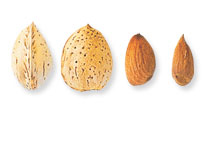
Nonpareil
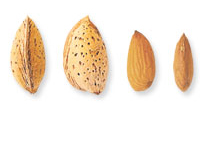
California
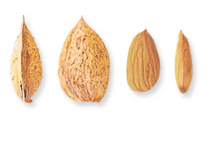
Mission
Major California Almond Varieties
It is possible to order California Almonds either based on the broad classification type or specific varieties. It is recommended to be very specific on either the specific variety or classification preferred when placing orders to ensure delivery of the exact almonds you intended. For example, ordering “Mission” without specifying “Mission Variety” could result in delivery of various almonds that fall under the “Mission Classification,” such as the Butte, Padre, or Fritz varieties.
| Variety | Classification Type | Harvest | Shell | Nut |
|---|---|---|---|---|
| Nonpareil | Nonpareil | Blooms and harvested early. | Soft shell; brown color; high suture opening. | Medium, flat shape; light color; smooth surface. |
| Carmel | California type | Harvested 25-30 days after Nonpareil | Soft shell; good shell integrity; fair suture opening. | Medium, narrow shape; slightly wrinkled surface. |
| Butte | California and Mission type | Harvested 25-30 days after Nonpareil; versatile kernel applications. | Hardshell; good shell; integrity; no suture opening. | Small, short, wide shape; wrinkled surface. |
| Padre | California and Mission type | Harvested 25-30 days after Nonpareil; similar to Butte. | Hardshell; good shell; integrity; no suture opening. | Small, short, wide shape; dark brown; wrinkle surface. |
| Mission | Mission type | Harvested 40–60 days after Nonpareil; strong flavor;not blanchable. | Hard shell; good shell integrity; no suture opening. | Small, short, wide shape; dark brown; wrinkle surface. |
| Monterey | California type | Harvested 40–60 days after Nonpareil; high percentageof doubles. | Hard shell; brown color;smooth surface; low suture opening. | Large, long narrowshape; deep wrinkled surface. |
| Sonora | California type | Harvested 7–10 days after Nonpareil; alternative to Nonpareil. | Paper shell; dark browncolor; rough surface; high suture opening. | Large, long narrow shape; light color;smooth surface. |
| Fritz | California and Mission type | Harvested 40–60 days after Nonpareil. | Soft shell; light color; goodshell integrity; low suture opening. | Small, medium plump shape; dark brown; fairly wrinkled surface. |
| Peerless | Inshell-Hardshell | Harvested 7–10 days after Nonpareil. | Hard shell; light color; good shell integrity;smooth surface; no suture opening. | Medium, wide shape;fairly wrinkled surface. |
| Price | California type | Harvested 7–10 days after Nonpareil; high percentage of doubles. | Paper shell; dark brown color; rough surface; high suture opening. | Small, short narrow shape; fairly wrinkled surface. |
Almonds Purchasing Considerations
| Factor | Parameters | Common Technology |
|---|---|---|
| VARIETY | Shape, color, skin texture or smoothness, blanchability | Nonpareil, Carmel, Butte, Padre, Mission, Monterey, Sonora, Fritz, Peerless, Price |
| SIZE* | * Count range of whole almond kernels per ounce (28.35 grams) | 18/20, 20/22, 23/25, 25/27, 27/30, 30/32, 32/34, 34/36, 36/40, or customer-specified range |
| GRADE | Dissimilar, doubles, chipped and scratched kernels, foreign material, split and broken kernels, other defects and serious damage | Fancy, Extra No. 1, No. 1 (Supreme), Select Sheller Run, Standard Shell Run, No. 1 Whole and Broken, No. 1 Pieces |
| IN-SHELL | Shell hardness, shell integrity, suture opening, kernel quality, crack out | Market specific, depending on how in-shell will be ultimately sold to consumers, for example: Traditional: sold in the shell—semi- or hard shell acceptable, cracked with a mechanical nut cracker Snack: sold in the shell—soft shell with greater suture opening to allow seasonings to permeate the shell Hand Crack: sold as kernels—soft shell preferred to allow manual cracking |
Common Packing For Container Shipment
| Products | Volume | Container |
|---|---|---|
| Natural Almonds | 25 lbs (11.3 kg) 50 lbs (22.7 kg) | 1000 Cartons in 20'FCL & 1720 Cartons in 40'FCL 720 Cartons in 20'FCL & 880 Cartons in 40'FCL |
| 2,200 lbs (1 mt) | Fiber bulk bin | |
| Cut Almonds | 25 lbs (11.3 kg) | 1000 Cartons in 20'FCL & 1720 Cartons in 40'FCL with plastic liner |
| 1,000 lbs (454 kg) 1,500 lbs (681 kg) | Fiber bulk bin with plastic liner | |
| Roasted Almonds | 25 lbs (11.3 kg) | 1000 Cartons in 20'FCL & 1720 Cartons in 40'FCL with vacuum-packed foil bags |
| In-Shell Almonds | 50 lbs (22.7 kg) | 720 Sacks in 20'FCL & 880 Sacks in 40'FCL |
Origin of Almonds with Production
[SUPER-INTERACTIVE-MAP ID=3]
Recomendations for storage
- Store under cool and dry conditions (<10°C/50ºF and <65% relative humidity)
- Almond moisture should be maintained at 6% or less
- Avoid exposure to strong odors as almonds can absorb odors of other materials if exposed for prolonged periods
- Protect from insects and pests
- Roasted products must be protected from oxygen. Nitrogen flushing and/or vacuum packaging are two options
- If kept under cold storage conditions (<5ºC/41ºF and <65% relative humidity), whole natural almonds can be stored for about two years with no significant loss in quality
- Rotate stock to optimize shelf life
| Nutrition Facts | |||
|---|---|---|---|
| Serving Size: 28gm | |||
| Amounts per servings | Calories from Fat 116 | ||
| Calories 161 | |||
| % Daily Values* | |||
| Total Fat 14 g | 22% | ||
| Saturated fat 1g | 5% | ||
| Polyunsaturated fat 3g | |||
| Monounsaturated fat 9g | |||
| Trans fat 0g | |||
| Cholesterol 0mg | 0% | ||
| Sodium 0mg | 0% | ||
| Potassium 197mg | 6% | ||
| Total Carbohydrate 6g | 2% | ||
| Dietary fiber 3g | 12% | ||
| Sugar 1g | |||
| Protein 6g | |||
| Vitamin A | 0% | Vitamin C | 0% |
| Calcium | 0% | Iron | 0% |
| Vitamin E | 0% | Vitamin B1 | 0% |
| Vitamin B2 | 0% | Vitamin B6 | 0% |
| Magnesium | 0% | ||
| *Percent Daily Values are based on a 2,000 Calorie diet. |
Facts on Almond Nuts
The almond (Prunus dulcis, syn. Prunus amygdalus) is a species of tree native to the Middle East, the Indian subcontinent and North Africa.
"Almond" is also the name of the edible and widely cultivated seed of this tree. Within the genus Prunes’, it is classified with the peach in the subgenus Amygdales, distinguished from the other subgenera by corrugations on the shell (endocarp) surrounding the seed.
The fruit of the almond is a drupe, consisting of an outer hull and a hard shell with the seed, which is not a true nut, inside. Shelling almonds refers to removing the shell to reveal the seed. Almonds are sold shelled or unshelled. Blanched almonds are shelled almonds that have been treated with hot water to soften the seed coat, which is then removed to reveal the white embryo


